What to Expect During a Certified Arborist Consultation
A good tree consultation rarely feels like a sales call. It feels more like a field inspection, part horticulture, part risk management, part long-term planning. If you have never scheduled a Certified Arborist Consultation before, the process can seem vague from the outside. Homeowners often expect someone to walk the yard, name a few trees, suggest trimming, and leave a quote behind. Sometimes that happens. More often, a proper visit goes deeper.
Trees are living structures with biology, mechanics, and site history written into them. An experienced arborist reads bark, branch unions, root flare, soil conditions, canopy density, decay patterns, and the subtle clues that tell you whether a tree is thriving, stressed, or quietly failing. The consultation is where that reading begins.
If the visit is done well, you should walk away with more than a price. You should understand what is happening with the tree, what level of urgency exists, what work is optional versus necessary, and what trade-offs come with each recommendation.
Why people call an arborist in the first place
Most consultations start with a practical concern. A branch is hanging over the roof. A tree is leaning after a storm. Mushrooms appeared near the base. The canopy looks thin. Roots are lifting a walkway. Sometimes the issue is less dramatic but just as important. A homeowner may be planning an addition, installing a driveway, selling a property, or trying to reduce fire risk.
In my experience, people usually fall into one of three groups. The first group is worried about safety. The second is trying to preserve a valuable tree. The third wants clarity before spending money. Those goals often overlap, and a strong arborist knows how to address all three without forcing the conversation toward immediate removal.
That last point matters. Tree Removal Services have a place, but removal should be a reasoned decision, not the default answer to every visible problem. Mature trees add shade, property value, stormwater benefits, privacy, and character that cannot be replaced quickly. On the other hand, waiting too long on a truly compromised tree can raise costs and increase risk. The consultation is where those competing realities get sorted out.
What happens before anyone steps into your yard
A professional consultation usually starts with a few questions before the appointment is even booked. You may be asked what concerns you have noticed, how long the problem has been present, whether there was recent storm damage, and if there are targets nearby such as houses, garages, vehicles, utility lines, play areas, or neighboring structures. Photos are often helpful, especially for Emergency Tree Services where scheduling depends on immediate risk.
You may also be asked about access. Narrow side yards, locked gates, septic systems, retaining walls, irrigation lines, and soft ground can all affect how work is performed later. If there is a chance that crane work, stump grinding equipment, or a bucket truck would be needed, access can shape the recommendation almost as much as the tree condition itself.
Some companies charge for a dedicated consultation, especially when the visit involves diagnosis, management planning, or a written report. Others Tree service offer a free estimate if the issue is straightforward. Neither approach is inherently better. The important thing is understanding whether you are booking a bid for tree work or a true professional evaluation.
The first few minutes on site tell you a lot
When the arborist arrives, pay attention to the kind of questions they ask before making pronouncements. A seasoned professional does not usually start with, “That needs to come down,” from the driveway. They want context. When did the lean begin? Has the site been excavated recently? Was there trenching for plumbing or electrical lines? Has the tree been topped in the past? Did last winter bring saturated soil and strong wind? Has construction compacted the root zone?
Tree decline is often a site problem before it becomes a tree problem. Grade changes, root cuts, overwatering, herbicide drift, heat reflected from new pavement, and buried root flares can all set a tree on a bad path years before symptoms become obvious. A careful arborist looks for those clues because they change both the diagnosis and the odds of recovery.
You can also expect the arborist to identify the species, or at least narrow it down if it is an uncommon ornamental or a cultivar with unusual characteristics. Species matters because trees fail in different ways. Some hold decay for years and compartmentalize it reasonably well. Others split suddenly at weak branch unions. Some tolerate aggressive Tree Pruning & Crown Shaping. Others respond poorly if too much live foliage is removed.
The inspection is broader than the trunk and branches
Homeowners naturally look at what they can see from eye level, but a proper consultation includes the whole system. The canopy gets attention, of course. Deadwood, crossing limbs, excessive end weight, lion-tailed branches, included bark, overextended laterals, and storm-damaged attachments are all important. Yet the lower trunk and root zone often tell the more urgent story.
An arborist will commonly check the root flare, the area where the trunk transitions into the main structural roots. When that flare is buried under fill, mulch, or years of debris, the tree may develop girdling roots, bark decay, chronic stress, and reduced anchorage. That can make a healthy-looking crown misleading. I have seen trees with decent leaf color and decent growth that were still poor candidates for retention because the base had begun to fail.
The surrounding site gets read too. Soil compaction from parking, poor drainage, signs of repeated ponding, fungal fruiting bodies, fresh cracks in the ground, and heaving on one side of the root plate can all affect the assessment. If the tree overhangs a home, the arborist is not just looking at the tree. They are looking at what the tree could hit if a limb or the whole structure fails. Risk is never about the tree alone. It is about the tree, the defect, and the target beneath it.
How a dangerous tree assessment is really made
The phrase Dangerous Tree Assessment and Removal can sound blunt, but the evaluation itself is usually nuanced. Trees do not fit neatly into safe and unsafe categories. Risk exists on a spectrum, and a good arborist explains that clearly.
A tree may have a defect that deserves monitoring but not immediate action. A second tree may be structurally compromised yet still reasonable to retain if pruning, cabling, and target management reduce the exposure. A third may have advanced basal decay or root plate instability and warrant prompt removal because failure is foreseeable and the consequences are severe.
Context changes everything. A declining oak in the back corner of a large lot may present low risk for years if there are no regular targets nearby. The same level of decay beside a child’s bedroom or over a busy driveway creates a different conversation. This is one reason online photos only go so far. Two trees can look similar in a picture and receive completely different recommendations in person.
A conscientious arborist will also tell you what cannot be known with certainty. Tree risk assessment is informed judgment, not fortune-telling. Hidden decay can be more extensive than it appears from the outside. Weather can accelerate failure. Root problems can progress unseen. If uncertainty is high, the best advice may lean conservative, especially where people or structures are at stake.
When pruning is the answer, and what kind of pruning matters
Many consultations end not with removal, but with a targeted pruning plan. This is where terminology matters. “Trimming” is a broad public term. Arborists usually think in objectives: deadwood removal, clearance pruning, structural pruning, crown reduction, thinning where appropriate, restoration pruning after storm damage, or Tree Pruning & Crown Shaping for aesthetics and form.
Those are not interchangeable services. A crown reduction involves shortening selected branches back to suitable lateral growth to reduce leverage and end weight. It can help manage risk and preserve natural form when done correctly. Topping, by contrast, is a damaging practice that leaves large wounds and stimulates weakly attached regrowth. Homeowners are often relieved when they hear there is a middle ground between doing nothing and “cutting it way back.”
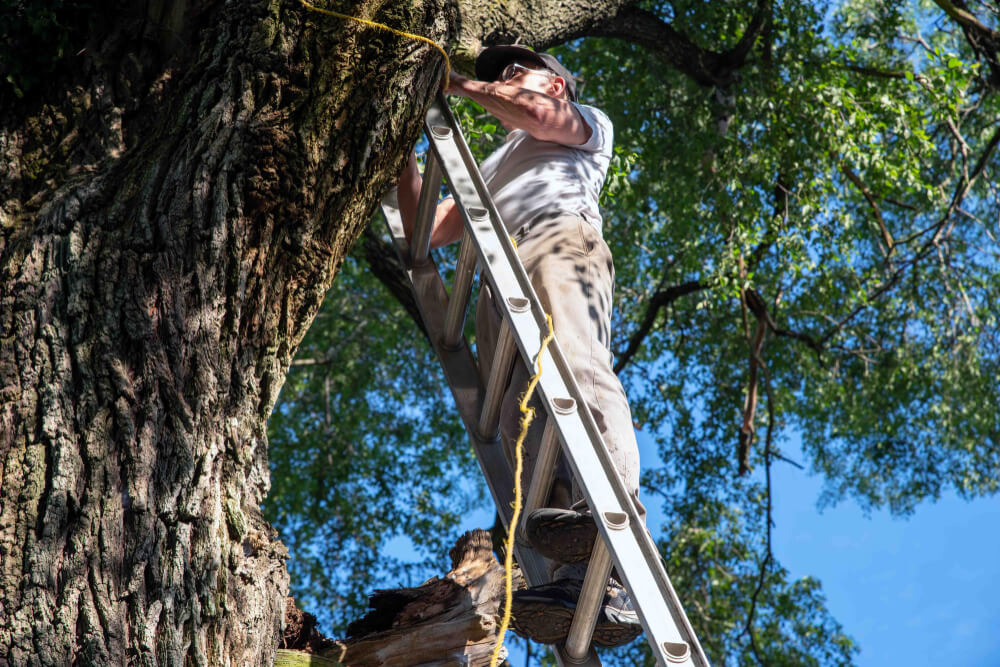
Pruning recommendations should reflect the species, age, defect profile, and season. Removing too much live canopy at once can stress a tree, especially in heat, drought, or pest pressure. In some cases the arborist may recommend staged pruning over several seasons. That is not an upsell by default. It is often the safer biological choice.
A real consultation also addresses expectations. If you want more sunlight in the yard, the arborist should tell you whether that goal can be achieved with selective pruning or whether the tree’s structure makes that unrealistic. If you want a tree made “hurricane proof” or “storm proof,” you should hear an honest answer: no pruning can eliminate all failure potential.
Support systems, cabling, and the cases where they help
Homeowners are sometimes surprised to learn that Tree Cable and Bracing is still a valid option for certain defects. Not every weak union requires removal, and not every split stem is a candidate for hardware. The consultation is where those distinctions are made.
Cables are often considered when codominant stems with included bark have value worth preserving and enough sound wood remains to support a system. Bracing rods may be used in more serious structural situations. These systems are not cosmetic fixes, and they are not permanent excuses to ignore a problem. They work best as part of a broader management plan that can include weight reduction pruning and periodic inspection.
A good arborist will explain the maintenance burden. Cabling a valuable mature tree may buy years of safe retention, but it also creates an obligation to revisit the hardware and reassess the tree. For some property owners, that is worthwhile. For others, especially where the tree is already in decline, removal may be the more practical long-term decision.
What removal conversations should sound like
When a tree truly needs to come down, the explanation should be specific. Vague language is not enough. You should hear what defects were observed, why they matter, what targets are exposed, and whether alternatives were considered.
Tree Removal Services vary widely in complexity. A small ornamental in open space is one type of job. A decayed conifer wedged between a house, fence, and service drop is another. During the consultation, the arborist may discuss rigging, crane access, sectional dismantling, traffic control, utility coordination, and whether work can be done from the ground or requires climbing.
This is also the stage where stump plans come into view. Some owners want the trunk removed and assume the rest disappears with it. In reality, Stump Removal & Grinding is usually a separate decision. Grinding below grade is common if you want to replant turf, improve appearance, or eliminate a tripping hazard. Full root extraction is much more invasive and is rarely necessary unless construction is planned in that exact footprint.
One detail many people miss is replanting compatibility. If you intend to install a new tree where the old one stood, the arborist may recommend offsetting the new planting hole rather than placing it directly into grindings and residual roots. That advice can save years of poor establishment.
Storm damage and emergency visits feel different
An Emergency Tree Services consultation tends to be faster, more focused, and more conservative than a routine site visit. If a tree is partially uprooted, hanging into another tree, split down the main stem, or resting on a structure, the first priority is immediate hazard control. Biology matters, but life safety and access come first.
In emergency situations, a certified arborist may limit the conversation to what can be stabilized today and what should be scheduled later once the site is safe. Not every storm-damaged tree requires removal, but some do. Fresh failures can expose hidden weaknesses in adjacent trees too, which is why a thorough emergency response often includes looking beyond the obvious broken stem.
Expect practical limitations here. Wet soils, active wind, utility hazards, and unstable hangers can delay full resolution. Responsible companies do not rush crews into unsafe conditions just to satisfy a same-day expectation. If the arborist recommends temporary barricades, restricted access, or waiting for the utility company before work begins, that is a sign of judgment, not hesitation.
Fire-prone areas bring a different set of priorities
In many regions, Wildfire Mitigation Tree Services are now part of routine consultations, not just rural specialty work. If your property sits near open space, canyon edges, grassland, or a forested interface, the arborist may assess ladder fuels, canopy spacing, accumulated dead material, overgrown understory, and the relationship between trees and structures.
The goal is not indiscriminate clearing. Effective wildfire mitigation is strategic. It may involve pruning lower limbs to increase vertical separation, removing dead or highly flammable vegetation near structures, reducing dense clusters, and selecting which trees to retain for shade without creating continuous fuel pathways.
This is one area where homeowners often struggle with aesthetics versus resilience. A screen of dense vegetation can feel private and lush until you look at it through the lens of ember exposure and flame length. An experienced arborist can usually suggest ways to preserve the character of the landscape while making meaningful reductions in fire risk.
What you should ask during the consultation
The best consultations are conversations, not lectures. If the arborist moves quickly, slow the moment down and ask for plain-language explanations. You do not need to know every technical term, but you should understand the reasoning behind the recommendation.
Useful questions often include these:
- What defect or condition concerns you most here?
- Is this an immediate risk, a medium-term problem, or something to monitor?
- What are the practical alternatives to removal?
- How will this work affect the tree’s health over the next few years?
- What maintenance or follow-up should I expect afterward?
Those answers will tell you a lot about the quality of the consultation. A skilled arborist can translate complex biology and structural concerns into language a property owner can use to make a decision.
Written recommendations, estimates, and the gap between them
One of the biggest points of confusion is the difference between an estimate and a recommendation. An estimate tells you what a company will charge to perform work. A recommendation tells you what work is appropriate and why. Sometimes those appear together. Sometimes they do not.
For simple pruning or removal, a concise estimate may be enough. For higher-stakes issues, especially disputes between neighbors, pre-construction planning, insurance concerns, or valuable specimen trees, a written assessment can be worth the extra cost. It creates a record of observed conditions and recommended actions at a given point in time.
Do not be surprised if two qualified arborists suggest slightly different approaches. Tree care has judgment built into it. One may recommend reduction pruning and annual monitoring for a mature maple with a weak union. Another may support Tree Cable and Bracing plus selective reduction. If both explain their logic clearly, the difference may reflect risk tolerance rather than incompetence.
Signs of a strong consultation, and a few warning flags
The best visits tend to share certain traits. The arborist spends time at the base of the tree, not just under the canopy. They ask about site history. They describe defects specifically. They separate urgent hazards from routine maintenance. They acknowledge uncertainty where it exists. They do not promise outcomes no one can guarantee.
There are also warning signs. Be cautious if the recommendation is immediate removal without inspection of the root zone or trunk base, especially for a tree that is not obviously failing. Be cautious if drastic pruning is sold as a cure-all. Be cautious if no one mentions species, defects, targets, or follow-up. And be especially cautious if the language leans on fear instead of evidence.
A Emergency Tree Services property owner once told me that three companies had visited her yard after a windstorm. Two declared a large sycamore “dangerous” from the driveway and proposed removal on the spot. The third walked the site, found the real issue in a torn scaffold over the garage, recommended a reduction and cleanup, and explained why the trunk itself remained sound. Years later the tree was still standing, still shading the home, and still manageable. That is the value of consultation over assumption.
What you should have by the end of the visit
By the time the arborist leaves, you should know where your tree stands now, what action is recommended, and how soon that action should happen. You should understand whether you are looking at routine Tree Pruning & Crown Shaping, monitoring, Tree Cable and Bracing, Dangerous Tree Assessment and Removal, Wildfire Mitigation Tree Services, or full Tree Removal Services with possible Stump Removal & Grinding afterward.
You should also have a realistic sense of cost drivers. Height, spread, decay, access, nearby targets, cleanup expectations, haul-away volume, and specialized equipment all shape pricing. The cheapest proposal is not always the least expensive outcome if poor work accelerates decline or leaves a preventable hazard in place.
Most of all, you should feel that the recommendation fits your property, not a script. Trees are too individual for canned answers. A proper Certified Arborist Consultation respects that. It combines biology, structure, site conditions, and owner priorities into a plan that makes sense now and still makes sense after the truck pulls away.
Name: Ace Tree Services Ltd.
Address: 4656 Wallace Hill Rd, Kelowna, BC V1W 4C2, Canada
Phone: 250-212-9593
Website: https://acetree.ca/
Email: [email protected]
Hours:
Sunday: Closed
Monday: 7:00 AM–5:00 PM
Tuesday: 7:00 AM–5:00 PM
Wednesday: 7:00 AM–5:00 PM
Thursday: 7:00 AM–5:00 PM
Friday: 7:00 AM–5:00 PM
Saturday: 7:00 AM–5:00 PM
Time zone: Pacific Time
Open-location code / Plus code: RHF8+8G Kelowna, British Columbia, Canada
Map/listing URL: https://www.google.com/maps/search/?api=1&query=Google&query_place_id=ChIJxRVIBx2LfVMRNRSkp6-IC0U
Embed iframe:
Socials:
https://www.facebook.com/p/Ace-Tree-Services-61585901931447/
Ace Tree Services Ltd. provides professional tree care from its Kelowna location on Wallace Hill Road.
The official website lists tree removal, stump removal and grinding, tree pruning and crown shaping, emergency tree services, certified arborist consultation, dangerous tree assessment and removal, tree cabling and bracing, and wildfire mitigation.
Ace Tree Services serves homeowners, businesses, and property owners in Kelowna and throughout the Okanagan Valley.
The company’s official site highlights ISA Certified Arborist support, local Okanagan experience, and fully insured tree service work.
Customers can contact Ace Tree Services for planned tree maintenance, high-risk removals, storm-related tree concerns, pruning, stump grinding, and arborist consultation needs.
The supplied public listing address is 4656 Wallace Hill Rd, Kelowna, BC V1W 4C2, near rural and residential service areas in southeast Kelowna.
For tree services in Kelowna and the Okanagan, call 250-212-9593, email [email protected], or visit https://acetree.ca/
The public map listing uses plus code RHF8+8G Kelowna, British Columbia, Canada and can help customers find Ace Tree Services Ltd. near Wallace Hill Road.
Popular Questions About Ace Tree Services Ltd.
What does Ace Tree Services Ltd. do?
Ace Tree Services Ltd. provides tree removal, stump removal and grinding, tree pruning and crown shaping, emergency tree service, certified arborist consultation, dangerous tree assessment and removal, tree cabling and bracing, and wildfire mitigation.
Where is Ace Tree Services Ltd. located?
Ace Tree Services Ltd. is listed at 4656 Wallace Hill Rd, Kelowna, BC V1W 4C2, Canada.
What phone number should customers call?
Customers can call Ace Tree Services Ltd. at 250-212-9593.
What is the email address for Ace Tree Services Ltd.?
The supplied email address is [email protected].
What are Ace Tree Services Ltd.’s hours?
The supplied listing hours show Monday through Saturday from 7:00 AM to 5:00 PM, with Sunday closed, Pacific Time. The official website lists 7:00 AM to 5:00 PM, Monday through Friday, so customers should confirm Saturday availability before booking.
Does Ace Tree Services Ltd. provide emergency tree service?
Yes. The official website lists emergency tree services, including emergency tree removal, dangerous tree assessment, emergency stabilization, and limb or branch cleanup.
Does Ace Tree Services Ltd. offer arborist consultations?
Yes. The official services page lists certified arborist consultation as one of the company’s Okanagan tree services.
Does Ace Tree Services Ltd. provide stump grinding?
Yes. The official services page lists stump removal and grinding as a service.
What areas does Ace Tree Services Ltd. serve?
The official website states that Ace Tree Services serves Kelowna and the Okanagan Valley.
How do I contact Ace Tree Services Ltd.?
Call 250-212-9593, email [email protected], visit https://acetree.ca/, or use the listed social profile: Facebook.
Landmarks Near Kelowna, BC
Wallace Hill Road: The road listed for Ace Tree Services Ltd. and a practical reference point for the company’s Kelowna location.
East Kelowna: A nearby rural and residential area where tree maintenance, pruning, removals, and wildfire mitigation can be important for property owners.
Myra-Bellevue Provincial Park: A major outdoor landmark southeast of Kelowna and a useful reference for the surrounding hillside and forested areas.
Gallagher’s Canyon: A nearby Kelowna community with residential properties, mature trees, and landscape maintenance needs.
Kettle Valley: A southeast Kelowna neighborhood with homes, parks, and landscaped properties.
Mission Creek Greenway: A well-known natural corridor in Kelowna and a local reference point for tree-lined recreation areas.
Orchard Park Shopping Centre: A major Kelowna retail landmark and citywide reference point.
Downtown Kelowna: A central business and residential district within Ace Tree Services’ broader Kelowna service area.
Okanagan Lake: A major regional landmark running through Kelowna and the surrounding Okanagan Valley.
Mission Creek Regional Park: A recognizable Kelowna park and natural landmark with extensive trees and trails.
Rutland: A large Kelowna community with residential and commercial properties that may need tree service support.
Glenmore: A Kelowna neighborhood with homes, parks, and established trees.
Lower Mission: A residential and lake-adjacent Kelowna area where pruning, tree health, and property safety can matter for homeowners.
Kelowna International Airport: A major transportation landmark north of central Kelowna.
West Kelowna: A nearby Okanagan community across the lake and a practical regional service reference.
For tree removal, stump grinding, pruning, crown shaping, emergency tree service, arborist consultation, dangerous tree assessment, cabling and bracing, or wildfire mitigation near these Kelowna and Okanagan landmarks, contact Ace Tree Services Ltd. at 250-212-9593, email [email protected], or visit https://acetree.ca/